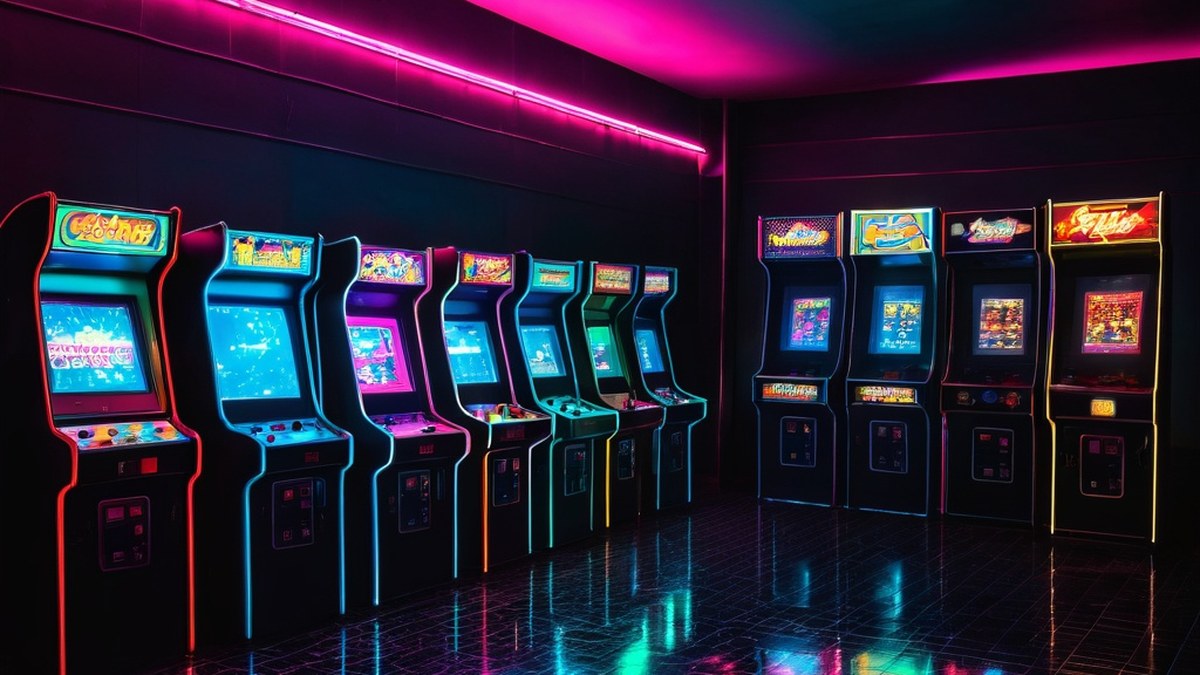
Arcades: The Quarter-Fed Cathedrals of the 80s
Before consoles brought the games home, arcades were sacred spaces — loud, dark, alive with bleeps and the crack of joysticks, and packed with teenagers who had nowhere better to be.
You smell it before you hear it, and you hear it before you see it. The faint fog of cigarette smoke that clung to the entrance even in the non-smoking sections — because there weren’t really non-smoking sections, not properly. Then the noise: an overlapping wall of synthesised sound, each machine broadcasting its own jingle at full volume, none of them competing because each one was already winning in its own corner. Then the darkness. Arcades were always dark, even in the middle of a bright afternoon, and the screens glowed in that darkness like stained glass.
That was the arcade. A cathedral built not for worship but for the ritual expenditure of quarters, for the very specific kind of social glory that came from topping a leaderboard in front of strangers.
The Machines That Mattered
The golden age of the arcade is generally marked from about 1978 to 1986, though its edges are soft and debated. Space Invaders had arrived from Japan in 1978 and caused something close to a national coin shortage — operators genuinely struggled to keep their machines stocked with enough quarters. Pac-Man followed in 1980, first in Japan and then in the United States, and it did something unprecedented: it attracted women and younger children who had been mostly absent from arcades before. There was something non-threatening about the cheerful yellow circle being chased by ghosts, something almost cartoonish, and Pac-Man became a cultural event well beyond gaming. By 1982, it had generated more revenue than any other entertainment product in American history, including Star Wars.
Donkey Kong arrived in 1981 and introduced a mustachioed carpenter named Jumpman who would later become Mario — though nobody knew that then. The game was created because Nintendo needed to convert a warehouse full of unsold Radar Scope machines into something that would sell, and Shigeru Miyamoto was handed the task. The result was one of the most important games ever made. You could argue that Donkey Kong invented the platformer, the narrative game, and the Nintendo company all at once.
The machines themselves were furniture. They were imposing wooden cabinets that stood four feet tall, bolted to the floor in some establishments, and they had a weight and presence that demanded respect. The control panels were worn smooth at the joystick and buttons from thousands of hands. Some games had their own unique controllers — the steering wheels in Pole Position, the trackball in Missile Command, the two-player duelling setup of Joust — and this physical specificity was part of the experience. You couldn’t replicate it at home. You had to go there.
The Social Architecture of the Arcade
Arcades occupied a strange social position. They were technically public spaces, but they operated with their own unwritten rules of belonging. A new player would approach a machine that someone else was already on and place a single quarter on the screen ledge — a wordless claim to the next game. Nobody taught you this. You just knew it. The hierarchy of the arcade was based entirely on skill, which made it genuinely meritocratic in a way that school never was. The kid who could clear twelve levels of Galaga didn’t need to be popular or athletic or well-dressed. He was already someone.
The sounds were as social as anything. When Street Fighter II arrived in arcades in 1991 — a little late for what historians call the golden age but central to the arcade’s second wind — the roar of a fireball, the crack of a Sonic Boom, became a shared language. You knew what that sound meant from across the room. You navigated toward it. By 1991 and into 1992, Street Fighter II cabinets had lines three deep in every decent arcade in the country, and the game that people were playing on those machines was a fundamentally social experience: you needed an opponent, and you’d play strangers without hesitation.
Mortal Kombat arrived in 1992 and caused a national moral panic that only made it more attractive. The blood. The fatalities. Parents and politicians talked about it as though the game was somehow corrupting children into violence, which was exactly the kind of attention that made eleven-year-olds desperate to play it. When the SNES version came out with the blood removed and a “sweat” code substituted, it felt like a betrayal. The arcade version had the real thing, and the arcade was where you went to see it.
The Economy of the Quarter
There was an entire financial ecosystem built around the quarter. You’d arrive at the arcade with a pocketful of them, or you’d change a dollar bill at the token machine near the entrance, and the exchange rate mattered. Four quarters to the dollar meant four games, more or less, depending on how well you played. The very best players could nurse a single quarter through half an hour of play. Most of us were feeding machines every four or five minutes.
This created a particular kind of attention economy. You watched other players not just for entertainment but to learn, to understand patterns, to figure out why they were lasting so long and you weren’t. The information was genuinely hard to come by elsewhere. Gaming magazines published tips and maps, but watching someone who actually knew what they were doing was worth more than anything you could read. The arcade was an oral tradition.
Tokens added another layer. Some establishments moved to proprietary tokens in the late 80s, partly to discourage counterfeiting and partly because it psychologically distanced players from the real money they were spending. A token didn’t feel like a quarter. It felt like something already spent, already converted, and so the barrier to dropping another one was lower. This was not accidental.
The Sounds and the Smell
Describing the soundscape of an arcade to someone who never experienced it requires more imagination than most descriptions deserve. It wasn’t chaos exactly — it was layered. Each machine had its own musical signature, and over time the regulars learned to hear them individually even in the mix. The thwump of Pac-Man’s death, the cascading notes of a Galaga stage clear, the digitised voice of Mortal Kombat’s announcer — “Finish him!” — hanging in the air above everything else.
The smell was inseparable from the experience. Industrial carpet that had absorbed years of spilled soda. The faint electrical warmth of dozens of CRT monitors running at full brightness. Carpet deodoriser that never quite won. If you were in a dedicated gaming hall in a mall, there was usually food nearby — a hot pretzel stand, a food court — and that mixed in too. The whole thing was its own atmosphere, literally and figuratively.
Why Home Consoles Could Never Really Win
When the NES arrived in 1985 and demonstrated that home gaming was genuinely viable again after the crash of 1983, it didn’t kill the arcade — not immediately. For most of the late 80s, arcade hardware was years ahead of anything you could buy for the living room. The home versions of arcade games were tributes, approximations, things that gestured at the original without matching it. Everyone understood this, and everyone accepted it. You played the NES version of Pac-Man because it was what you had at home, but you knew it wasn’t the real thing.
By the early 90s, that gap had narrowed enough to matter. The SNES could produce a port of Street Fighter II that was recognisably the same game. The Sega Genesis could handle Mortal Kombat’s hardware demands well enough. And as consoles improved, the economic argument for arcades weakened. Why feed quarters into a machine when you could buy the cartridge and play it forever?
But here’s what home consoles couldn’t replicate, no matter how good the hardware got: the room. The crowd. The stranger standing next to you watching, the small performance of playing well in public, the quarter on the screen ledge that meant someone was waiting. The arcade wasn’t really about the games in isolation. It was about playing games as a communal act, in a shared space that existed for no other purpose.
That space is gone now. A few preserved arcades remain — retro bars that charge flat entry fees and keep their machines set to free play — and they’re lovely, but they’re not quite the same thing. The original arcades had stakes. Your quarter was on the line. The person next to you was a stranger and also a witness. You were performing, even when you didn’t mean to be.
What the arcade actually was, underneath all the noise and the neon and the specific smell of worn carpet, was one of the first places where a kid could be genuinely excellent at something in front of other people without needing an adult to certify it. The machine judged you. The high score was the record. Your initials were the monument. In a world where most forms of recognition required permission from someone older, that mattered more than it probably should have, and probably more than most of us understood at the time.