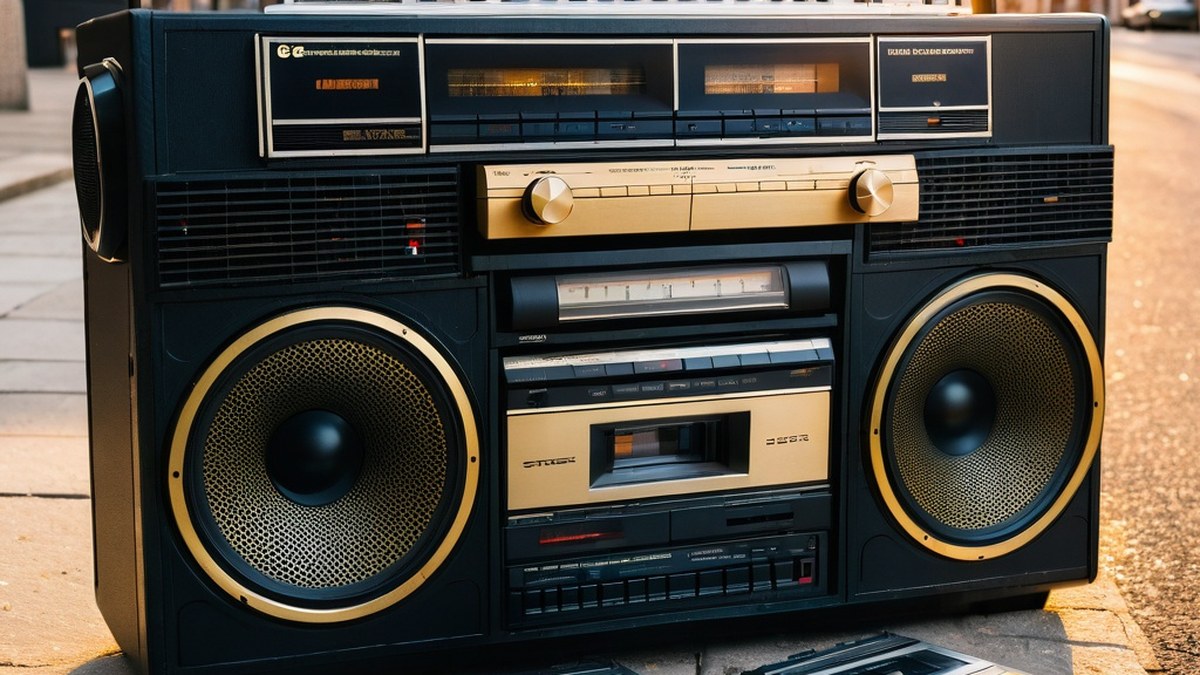
Boomboxes: When Music Was Something You Carried on Your Shoulder
Long before wireless speakers, the boombox was the most powerful statement you could make about your relationship with music — and everyone in earshot.
Imagine carrying thirty-five pounds of electronics on your shoulder. Now imagine doing it because the alternative — leaving your music at home — was genuinely unacceptable. The boombox was not a convenient device. It was not designed for convenience. It was designed to be loud, to be visible, and to make absolutely clear that wherever you went, your music came with you, and you didn’t especially care what anyone else thought about that.
This was, in the early 1980s, a radical proposition.
The Machines
The boombox — also called the ghetto blaster, the jambox, the box, or simply the radio — emerged from a specific collision of Japanese consumer electronics ambition and American urban culture. Japanese manufacturers including JVC, Sharp, Sanyo, Panasonic, and Sony were competing ferociously throughout the late 1970s, each trying to outspec the others on portability, power, and features. What they produced, in their race to the top, were monsters.
The JVC RC-M90, released in 1981, is still considered by many collectors to be the apex of the form. It weighed nearly nine kilograms and required ten D-cell batteries to run — a set that cost more than a few dollars and lasted, depending on volume, somewhere between eight and twelve hours. Its twin cassette decks allowed real-time dubbing, a feature that felt technologically profound at the time. Its speakers, at roughly 18 watts per channel, could fill a city block if you turned them up. The RC-M90 retailed for around $400 in 1981. That is approximately $1,300 in today’s money. People paid it.
Sharp produced its own legend in the GF-777, nicknamed the “Searcher.” Panasonic had the RX-5090. Sony’s CFS-W40 was smaller and more portable but still enormous by any reasonable measure. These were not products you bought for subtlety. They were statements, and they were priced accordingly.
The Battery Economy
Running a full-size boombox on batteries was an exercise in resource management that nobody talks about anymore. D-cell batteries — the largest common consumer battery — drained quickly under the load of high-volume playback. A fresh set of ten might last you a day in the park. By the end of it, you’d know the batteries were dying because the music would start to slow slightly, the bass would soften, the whole sonic picture would flatten.
This created a genuine economy. Rechargeable batteries existed but were expensive and not particularly good. The practical solution, for most boombox owners, was to buy batteries in bulk from discount stores or warehouse clubs, or to run an extension cord out of a window when you were near home. The image of the boombox in the park or on the street corner is accurate, but so is the less glamorous image of the boombox plugged into a kitchen outlet with twenty feet of orange extension cord running across a sidewalk.
Carrying a boombox also meant carrying the batteries, and carrying the batteries meant weight. The physical commitment required to have music with you was non-trivial. You chose to do it anyway. That choice meant something.
A Specific Cultural Moment
In the summer of 1982, Afrika Bambaataa and the Soul Sonic Force released “Planet Rock.” It was not the first hip-hop record, and it was not the first to be played on a boombox in a New York park. But it arrived at a moment when the convergence of hip-hop, breakdancing, and boombox culture had reached a kind of critical mass. Parks in the South Bronx, in Harlem, in Brooklyn, were becoming places where music didn’t just happen — it was performed, argued over, competed with. If someone set up a boombox on one end of a park, someone else might set up a bigger one at the other end, and the battle was partly sonic, partly social.
This is not hyperbole. Battles between sound systems were a genuine feature of early hip-hop culture, and the boombox — the portable, battery-powered, shoulder-carried version of a sound system — was the individual’s weapon in that battle. The bigger your box, the louder your music, the more clearly you were asserting presence. “Planet Rock” played on a JVC RC-M90 at full volume in a concrete park was not merely music. It was an announcement.
From the Bronx to the Boulevard
By the mid-1980s, the boombox had escaped its specific geographic and cultural origins and become a mainstream phenomenon. Suburban teenagers in Iowa carried them to parks. British kids brought them to the seaside. The device appeared in films — most iconically, John Cusack hoisting a boombox above his head in Say Anything (1989), blasting Peter Gabriel’s “In Your Eyes” at Ione Skye’s window, a moment so perfectly pitched that it became a shorthand for romantic gesture for an entire decade.
But that mainstream moment also carried a certain tension. The boombox had arrived in white American consciousness via hip-hop, via breakdancing, via the visual language of early rap videos. The people who had invented this culture were, in many cases, the same people police departments were attempting to ban from public spaces. Some cities passed ordinances against boomboxes in parks and on public transport. New York’s subway system banned them in 1982. The enforcement of those bans had a very specific racial character that wasn’t accidental.
The boombox was a political object in a way that the Walkman never was. One was about private escape. The other was about public presence. The act of carrying a boombox through a neighbourhood was the act of claiming that neighbourhood acoustically — saying, I am here, I am loud, I am not interested in being invisible.
The Decline and the Legacy
By the late 1980s and early 1990s, the classic boombox was beginning to fade. Car audio systems were getting better, home stereos were getting cheaper, and the cultural moment that had made the massive shoulder-carried box feel essential was shifting. Hip-hop culture moved indoors, to clubs and studios. The devices themselves evolved — smaller, lighter, with CD players replacing or supplementing cassette decks — but they lost something in the downsizing.
The real inheritor of the boombox is the Bluetooth portable speaker. The JBL Charge, the UE Boom, the big Sony XB series with its colour-changing lights — these are all essentially attempts to recreate the boombox proposition in a lighter, wireless-friendly package. You can bring your music with you. You can make it loud. You can place it at the centre of a gathering and let it do the thing music at volume does, which is pull people toward each other.
But a two-kilogram Bluetooth speaker sitting on a picnic blanket doesn’t carry the weight of what a nine-kilogram JVC RC-M90 carried — literally and otherwise. The boombox was a commitment. It told everyone around you something specific and unmistakeable about your priorities. Music was not background. Music was not something you listened to quietly with headphones out of consideration for others. Music was something you brought into the world with you, at volume, and dared the world to argue.