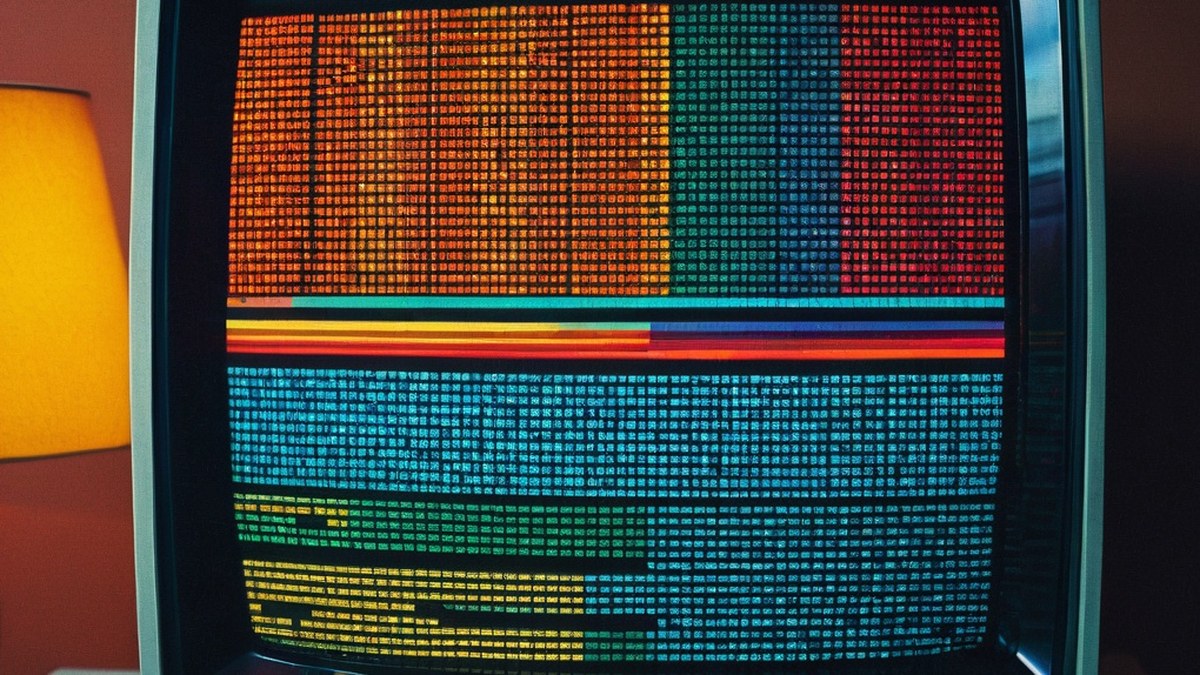
Ceefax and Teletext: The Internet Britain Had Years Before the Internet
Blocky coloured text beamed invisibly inside the TV signal itself, giving you the news, the football scores, and a holiday booking service, one slow page at a time.
The BBC’s Ceefax service launched in 1974, and the fact that it predates the World Wide Web by roughly two decades is the single most important thing to understand about it, because everything about Ceefax, and its ITV commercial counterpart Oranges (later Teletext, after the format’s generic name), was quietly doing something that looked, in retrospect, remarkably like the internet, using nothing more than a television set, a remote control, and data smuggled inside a broadcast signal that was already being sent to every home in the country for an entirely different purpose.
The technical trick was genuinely clever: television signals contain unused lines in the vertical blanking interval, the brief gap between frames that the picture itself doesn’t use, and Ceefax encoded its pages of text and simple block graphics into those spare lines, broadcasting the entire service continuously, invisibly, as a kind of free hitchhiker riding on the ordinary television signal. A teletext-capable television (initially a premium feature, later standard on most sets) would decode this hidden data and let you browse it using the remote control, entering a three-digit page number to jump directly to whatever you wanted.
Three Numbers and a Very Long Wait
The experience of using Ceefax or Teletext had a rhythm entirely its own. You knew the page numbers for the services you used regularly — the way you might know a phone number by heart — and you’d type in your three digits and then wait, because the signal transmitted continuously and cyclically rather than on demand, meaning your requested page might be broadcast immediately or might take a frustrating number of seconds (occasionally feeling like much longer) to come back around in the cycle. There was no way to speed this up. You typed your number and you watched a small progress indicator and you waited, and the waiting became such a universal, understood part of the format that nobody really complained about it as a flaw.
Once a page did load, you got blocky, low-resolution coloured text and simple graphics built from a limited character set — genuinely crude by any later standard, but entirely legible, and astonishingly information-dense for a format riding for free on a TV signal. News headlines, with the ability to drill into a fuller story by following a referenced page number. Full football results and league tables, updated continuously on match days, checked by millions of fans with no other way to get instant scores outside radio commentary. Weather forecasts, broken down by region. TV listings for the day and the week ahead, often more detailed than the printed TV guide.
Holiday Bargains, Share Prices, and the Small Ads of a Nation
Teletext’s commercial ITV version, in particular, became closely associated with late-night holiday deals — entire sections of the service dedicated to last-minute package holiday bargains, scrolled through page by page by people hunting for a cheap week in Spain, a format that functioned as a genuine, if primitive, precursor to online travel comparison sites. Financial pages carried share prices and currency rates. Some regional services carried small ads, flat listings, even early dating and chat services, accessed entirely through a television remote and a willingness to wait for pages to cycle round.
Subtitles, too, were delivered through the same teletext infrastructure, a function that long outlived the rest of the service’s practical usefulness and remains, technically, the ancestor of how subtitles are still encoded in broadcast television today — one of teletext’s quiet, lasting legacies, invisible to most viewers who use it.
A Format Built for a World Before the Web
Ceefax and Teletext thrived specifically because they filled a genuine gap: instant, continuously updated information, available to anyone with an ordinary television, at a time when getting the same news, scores, or listings any other way meant waiting for the next radio bulletin, the next newspaper, or a phone call to a service that might charge you for the privilege. It was never going to survive the arrival of an actual internet connection in the home, which offered everything teletext did, on demand rather than on a broadcast cycle, with none of the three-digit page numbers or the wait.
The BBC switched off Ceefax in October 2012, timed to the digital television switchover that made the analogue signal teletext relied on obsolete; ITV’s Teletext service had already closed its consumer-facing operation some years earlier. The shutdown passed with a genuine, if modest, wave of affectionate coverage — a recognition that something distinctly British and distinctly clever was disappearing, even among people who hadn’t actively used it in years.
What’s easy to forget now is how completely ordinary Ceefax felt at the time, for the roughly two decades it was genuinely useful. Checking the football scores on page 302, or the weather on 401, or the TV listings on whatever number you’d long since memorised, wasn’t a novelty. It was just how you found things out, using a television that was already on anyway, for a service that cost nothing extra and existed, invisibly, in signal nobody else was using. It’s hard to think of many pieces of British infrastructure that disappeared this completely, this quietly, having once been this genuinely useful to so many people every single day.