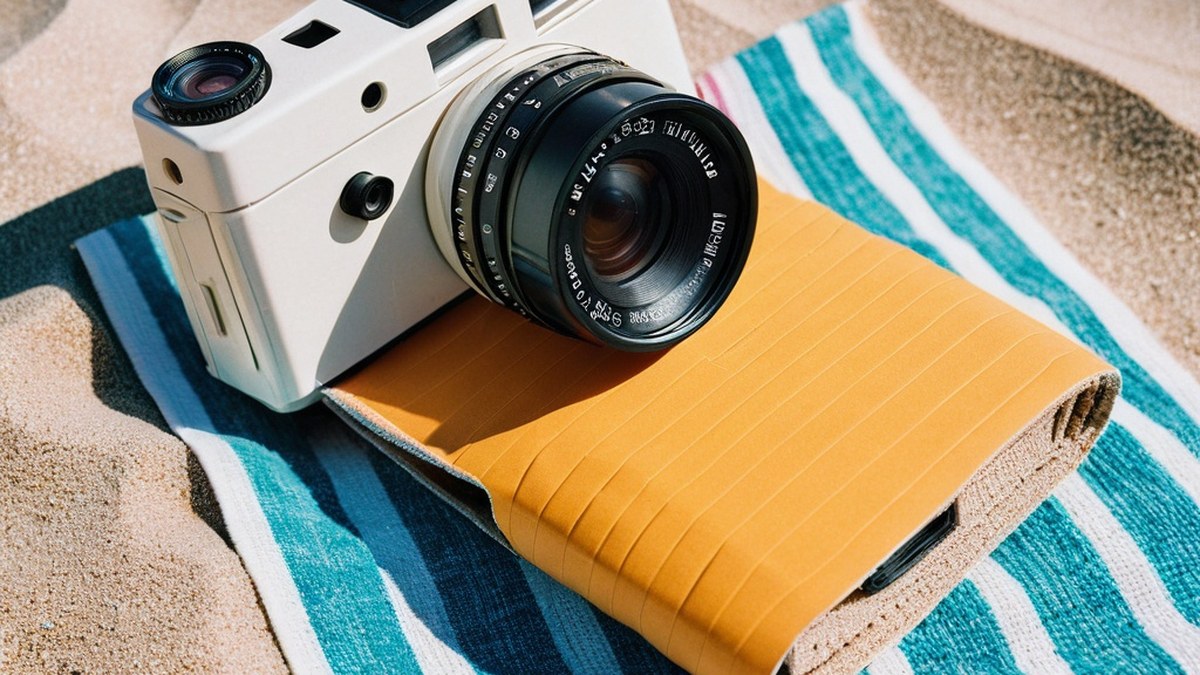
Disposable Cameras: 27 Shots and No Second Chances
A fixed lens, a plastic body, and 27 exposures to capture an entire event. You didn't know what you had until a week later, and somehow that was fine.
Somewhere in a shoebox under someone’s bed, there are photographs from a night that everyone who was there remembers differently. Half of them are slightly blurry. One is taken from a weird angle that cuts off whoever was standing on the left. The flash has turned everyone’s eyes a dramatic shade of red, and the colours have the warm, slightly orange cast that all disposable camera photos have, as if every moment in the 1990s was bathed in the same perpetual golden hour. The photos are terrible by any technical standard, and also irreplaceable, and also the only evidence that the night actually happened.
This is the disposable camera’s legacy: not precision, but presence. Not documentation, but memory.
The Camera You Bought at the Drugstore
Fujifilm introduced the first widely available disposable camera in Japan in 1986, under the name Utsurun Desu — roughly translated as “it takes pictures.” Kodak followed in the United States in 1987 with the Fling, which was later renamed the FunSaver. The concept was simple and, once explained, seemed obvious: a camera pre-loaded with film, encased in a simple cardboard and plastic body, sold at a price low enough that returning it to the processor as part of the development transaction made economic sense. You didn’t get the camera back. You got the prints.
The price in the late 1980s was around $7 to $10 for a basic model. By the 1990s, you could find them at pharmacies, convenience stores, petrol stations, supermarkets, airport gift shops — anywhere that photographs might plausibly be wanted and where buying a proper camera would be impractical or inadvisable. They came in standard configurations and specialty versions: panoramic, underwater, with and without flash, 15 exposures or 24 or 27. The 27-exposure model was the standard for most of the format’s peak years.
The camera itself was not complicated. A fixed-focus lens — typically around 30mm equivalent — could produce acceptably sharp photographs of subjects between roughly four feet and infinity, which covered most situations where people wanted photographs. The flash ran on a single AA battery or a small built-in battery, charged via a lever you wound with your thumb before each flash shot. You could feel the capacitor charging. When it was ready, a small indicator light glowed red. Then you pressed the shutter, and the capacitor discharged, and the flash was bright and brief and usually either too close or too far for the subject.
The Discipline of 27 Frames
Twenty-seven shots. On a week’s holiday, that might seem generous. At a wedding that ran six hours across a ceremony and a reception, it was a series of decisions. At a party that started at 9pm and ended when everyone eventually left, it was a constant negotiation between capturing the moment and conserving film for moments not yet arrived.
This constraint shaped photographic behaviour in ways that are now difficult to fully reconstruct because they have been so completely superseded. People thought before they shot. Not carefully or artistically, necessarily, but they thought: is this worth one of my remaining exposures? Is this the right moment? The counter on the back of the camera ticked down, and you knew it, and the knowledge created a mild but real pressure that influenced what got photographed and what didn’t.
There was no review. You pressed the button, the shutter clicked, the film advanced by one frame, and the moment was captured or it wasn’t. You had no way of knowing. If you blinked, the photo had a closed eye in it. If the flash fired before everyone was ready, the photo had everyone looking slightly startled. If you moved slightly during the longer exposures of low-light shots without flash, the photo was blurred. All of these outcomes were possible, and none of them could be corrected, and you would not know for approximately a week which ones had occurred.
The Week of Not Knowing
The ritual of developing film was a specific and now largely extinct experience. You finished the roll — wound the last frame, or decided you’d taken enough and handed the camera in with a few shots unused — and you dropped it off. At a pharmacy, usually. At a dedicated photo counter in a larger shop, or at one of the standalone photo development kiosks that appeared in shopping centres through the 1980s. You got a ticket. You came back.
The standard development time was an hour for many services by the mid-1990s, but for disposable cameras dropped off in bulk at pharmacy counters, it was often more like a week. Some people waited longer by accident, forgetting to pick up the prints or putting it off. The ticket sat on the kitchen counter for a while.
When you came back and opened the envelope, you were seeing photographs for the first time. Some of them looked exactly as you remembered the moment. Some of them captured something you had completely forgotten — a facial expression, a background detail, a person standing off to one side. Some of them were mysteries: a blurred shape, an extreme close-up of someone’s ear, a photograph of the ceiling taken when the shutter fired accidentally. These mysteries were as much a part of the experience as the successful shots.
The photographs from a disposable camera at a school prom in 1998, or a family holiday in 2001, or a graduation party in the summer of 1996 have a specific look that is not reproducible by digital filters. The grain is real grain, silver halide crystals that responded to light. The colour cast is the chemistry of the film reacting to particular light sources. The slight softness of the fixed-focus lens is optical physics. These are not aesthetic choices. They are the evidence of a specific technology making contact with a specific moment in the physical world.
The Wedding Camera and the Social Ritual
Through the 1990s and early 2000s, disposable cameras became standard equipment at weddings — placed on tables, available to guests, collected at the end of the evening. The logic was generous and practical: professional photographers captured the formal moments, but guests with disposable cameras captured everything else. Candid moments. Drunken dancing. Children running around the hall at 10pm. The moment the bride’s grandmother laughed so hard she had to sit down.
The disposable cameras on wedding tables were communal photographic infrastructure. Anyone could pick one up. Anyone could take a photograph of anyone else. The results were unpredictable, occasionally embarrassing, frequently wonderful, and usually developed weeks later when the couple was already back from their honeymoon and sorting through gifts. Finding a packet of 200 prints from guest cameras was like receiving a collectively assembled record of the night from multiple perspectives you hadn’t seen.
This was, in retrospect, a precursor to the idea of crowd-sourced event photography — the notion that many cameras distributed through a crowd produce a more comprehensive and emotionally varied record than any single professional can achieve. The disposable camera on the table was a low-tech version of an idea that Instagram and smartphone cameras would later operationalise at scale.
The Hipster Revival and What It Means
The disposable camera’s revival — which gathered momentum through the 2010s and has accelerated meaningfully in the 2020s — is partly aesthetic and partly reactionary. The aesthetic appeal is genuine: the film grain, the organic colour, the fixed-focus softness, the flash characteristics that digital processing can approximate but never quite replicate. Instagram filters gestured at these qualities. Actual film achieves them.
But the revival is also about something else. Using a disposable camera at a concert or a birthday or a weekend away is a choice to limit yourself — to accept 27 frames, no preview, a week’s wait, results that cannot be edited. It is a deliberate imposition of constraint in an era of unlimited digital capture, and the constraint changes the experience. You pay attention differently when you can’t take six hundred photographs. The camera becomes an object with weight.
What You Didn’t Know You Had
The disposable camera’s real contribution wasn’t photographic quality. It was democratic, spontaneous, imperfect capture of ordinary life at a particular moment in history. The photographs from a disposable camera at a teenage birthday party in 1994 are historical documents now — records of how rooms looked, how people dressed, how close together people stood, what was on the walls. None of that was the point at the time. The point was that someone thought to bring a camera, wound the flash, and pressed the button.
The imperfections are the record. The blur, the red eye, the slightly overexposed background, the person looking the wrong way — all of it is evidence of a moment that actually happened, captured by a device that could not lie about what it saw. The photograph you took on a disposable camera was what was there. Nothing more, nothing less, and exactly enough.