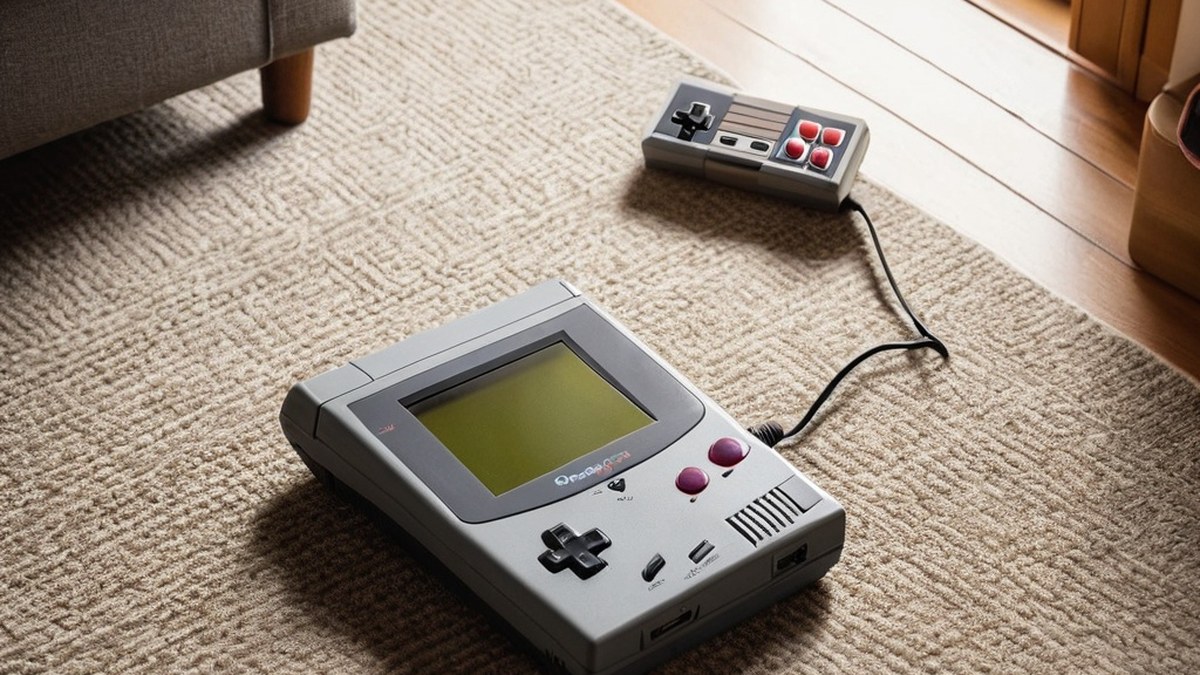
The Game Boy: A Brick of Joy That Ran on Four AA Batteries
Nintendo's handheld wasn't the most powerful, the most colourful, or the most technically impressive portable console on the market. It was just the one everyone had.
Somewhere under a bed, in a box in a garage, or in the back of a drawer that hasn’t been opened in fifteen years, there is probably a Game Boy. Not a sleek modern device but the original — the DMG-01, as Nintendo’s engineers designated it internally, where DMG stood for Dot Matrix Game. It is the size of a paperback novel, heavier than anything that size has any right to be, and its screen is a small greenish-grey rectangle that goes completely dark in anything less than decent lighting. It runs on four AA batteries, which get about fifteen hours of play before dying, and it is one of the most important consumer electronics devices ever manufactured.
None of that sounds like a recipe for success. In 1989, when the Game Boy launched in Japan at ¥12,800 and in North America at $89.99, it competed against hardware that looked, on paper, considerably more impressive. It was not the most powerful option. It was not the most visually striking. It was not even the most affordable. It was, by most technical metrics, the worst handheld on the market — and it sold 118 million units over its lifetime.
The Conservative Genius of the Design
Gunpei Yokoi, the Nintendo engineer who designed the Game Boy, had a philosophy he called “lateral thinking with withered technology.” The principle was simple: use cheap, proven, mature technology in creative ways rather than chasing the cutting edge. The Game Boy’s processor was based on the Z80 chip, which had been available since 1976. Its screen was a reflective LCD with no backlight, which meant it was difficult to see in low light but also meant the battery drain was minimal. The whole assembly was built to survive: the housing was thick, the buttons were sturdy, and the screen was recessed slightly to protect it from drops.
This was not a failure of ambition. It was a specific choice, and the choice was correct. The Atari Lynx, launched the same year, had a colour backlit screen and far more processing power — and it ate through six AA batteries in about four hours. The Sega Game Gear, which followed in 1990, was similarly more powerful, similarly colour, and similarly brutal on batteries. Kids who owned those machines spent enormous amounts of money on batteries or were tethered to a power outlet, which somewhat defeated the point of a portable console. Game Boy owners could carry a spare set of AAs and play through an entire long car journey without thinking about it.
The design was also genuinely pocketable in a way that mattered. It fit in the front pocket of jeans worn by an actual child, albeit tightly, and this meant it was always with you. The console you have with you beats the console you left at home. Yokoi understood this before the phrase “the best camera is the one you have with you” became a cliché.
Tetris and the Killer App
The Game Boy launched in North America bundled with Tetris, and this decision — made partly because of complicated legal negotiations that Nintendo pursued specifically to secure Tetris for the handheld — may be the single most consequential software bundling decision in gaming history.
Tetris was, and remains, one of the most perfectly formed games ever created. Alexey Pajitnov had designed it in 1984 at the Soviet Academy of Sciences in Moscow, using falling tetrominoes on a simple grid, and its elegance was immediately apparent. The Game Boy version, developed by Nintendo with a specific two-player versus mode via the Link Cable, was ideally suited to the hardware. It worked perfectly on the small screen. It required no colour. It needed no complex graphics. And it was the kind of game you could pick up for five minutes on a bus or play for three hours at a stretch without it feeling inconsistent — the feedback loop was tight enough for short sessions, deep enough for long ones.
More importantly, Tetris reached demographics that weren’t traditional gamers. Adults who had never played Super Mario Bros. would sit quietly in waiting rooms with a Game Boy, dropping blocks. Parents who bought the console ostensibly for their children would find themselves playing. A Newsweek cover from 1990 showed a Game Boy beneath the headline about the “Tetris craze,” and that’s a reasonable summary of what happened in the first years: the Game Boy sold Tetris, and Tetris sold the Game Boy, and together they expanded the idea of who a gamer was.
Under the Covers
There was a particular ritual for serious Game Boy players, and it required either a very dedicated parent or a completely unsupervised child. You were in bed. The lights were off because they were supposed to be off. But the game wasn’t finished. The dungeon wasn’t cleared, or the Tetris session was going well, or you’d just found something important and couldn’t stop now.
The Game Boy screen was not visible in darkness. It had no backlight, and the reflective LCD needed ambient light to function. Several third-party accessories existed to address this: clip-on lights that attached to the top of the console and aimed a small beam at the screen, running off the same AA batteries as the unit itself and draining them considerably faster. Worm Light was a popular one — a flexible gooseneck lamp in translucent plastic that glowed a gentle pink-orange colour. Under the covers, with a Worm Light attached, the Game Boy was a tiny glowing secret in the dark.
The batteries would often die at the worst possible moment. The screen would dim to a warm amber, then go grey, then nothing. The only sound was the tiny click of the power switch being flipped off and on uselessly, as though the console might reconsider. Then the long walk to the kitchen to find batteries, in the dark, as quietly as possible.
The Family Tree
Nintendo understood that the Game Boy platform had longevity and iterated carefully. The Game Boy Pocket arrived in 1996 — smaller, lighter, with a cleaner screen and a grey colour that looked more adult than the original’s awkward beige. The Pocket needed two AAAs rather than four AAs, and many considered its screen marginally sharper. It sold on aesthetics as much as function, and it worked.
The Game Boy Color followed in 1998, a genuine update rather than just a cosmetic revision. The colour screen ran at 160x144 pixels and could display up to 56 colours simultaneously. Crucially, it was backward compatible with all existing Game Boy cartridges, which it displayed in a palette Nintendo had selected for each title. Link’s Awakening in an approximation of colour, Pokémon Red and Blue tinted green, the entire original library suddenly new again. And Pokémon — Red and Blue having launched in North America in September 1998, just as the Color arrived — was driving a wave of demand that even Nintendo’s most optimistic projections hadn’t fully anticipated.
The Game Boy Advance in 2001 was a more dramatic leap: a 32-bit processor, a wider landscape-orientation screen, shoulder buttons, and hardware capable of producing visuals roughly equivalent to the SNES. The Advance SP in 2003 added a backlit clamshell design, and the game-under-the-covers problem was finally, officially, solved.
What the Brick Actually Meant
The technical story of the Game Boy is interesting. The emotional story is something else.
For a generation of children, the Game Boy was the first piece of technology that was entirely theirs. Not the family TV, not the shared console in the living room, but a personal device, carried in a bag, powered by batteries you could buy at any petrol station or corner shop, that existed outside the normal rules of family screen time. It was private in a way that the TV and the home console were not. Your Game Boy was yours. Nobody else was waiting for it, nobody was going to change the channel, nobody was going to tell you the session was over because something else needed to happen in the room.
The Link Cable let you share that private world with one other person — sitting on opposite sides of a classroom desk, cables running between you, playing Tetris or Pokémon trades without speaking. It was intimate in the way that passing notes was intimate: a private channel in a public space.
What Yokoi designed, probably without framing it this way, was the first genuinely personal gaming device — a machine that belonged to the person using it in a way that arcade cabinets and living room consoles never quite did. That the machine was heavy, greenish, and required four AA batteries to run seems, in retrospect, entirely beside the point.