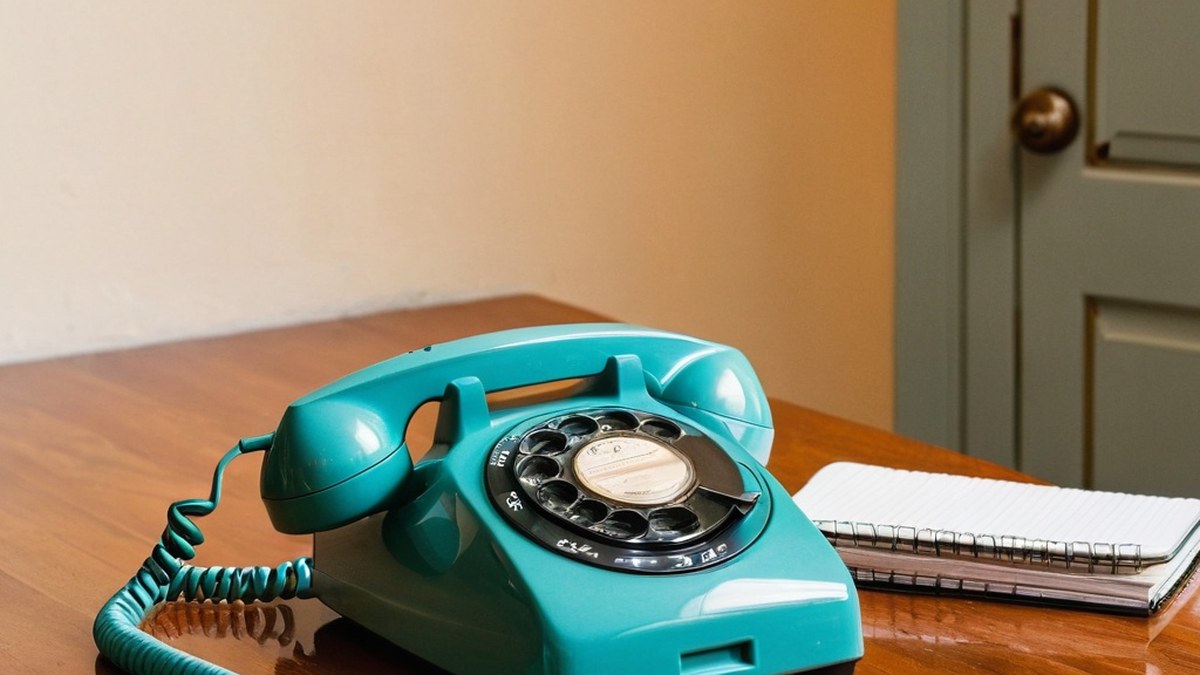
Landline Phones: When the Phone Belonged to the House, Not the Person
Before every person had a phone in their pocket, there was one phone in the kitchen, one in the hallway, maybe one in the bedroom — and it belonged to the whole family.
You called a house. That was the thing, the detail that no longer maps onto any modern experience. You picked up the phone, dialled a number you had memorised because there was no other way to store it, and then waited to find out who would answer. It might be your friend. It might be your friend’s father, who would make you explain yourself before agreeing to go get her. It might be a younger sibling who would breathe heavily into the receiver and then put it down without saying anything. You had no way to know in advance. The call was an act of faith directed at a location.
This is a fact that is genuinely difficult to explain to anyone who grew up after the mid-2000s, when the idea of a phone that belongs to a person rather than a place became total and unremarkable. A landline phone was a fixture of the house. It had a number, and that number was the house’s number, listed in a directory under the name of whoever paid the bills. Calling someone meant calling their home, not them.
The Kitchen Wall and the Bedroom Extension
The geography of the household phone was a domestic architecture all its own. In most homes, the primary phone was in the kitchen or the hallway — a practical location, near the centre of household activity, where messages could be taken and the cord could reach the counter. That cord was critical. A standard coiled handset cord, fully extended, might reach eight or ten feet. That was your radius of movement. You could open the refrigerator while talking, or lean against the counter, or pace a small loop — but you couldn’t leave the room. The conversation happened in the kitchen, and everyone in the kitchen could hear it.
Privacy, for a teenager, meant one thing: the bedroom extension. A phone in your room was the equivalent of a private line. You could close the door. You could lie on your bed and talk for an hour. You could say things you wouldn’t say in the kitchen with your mother making tea three feet away. The bedroom phone was a rite of passage, something lobbied for, eventually granted, occasionally revoked as punishment. If your household had one, you understood its value precisely because you had once done without it.
But even the bedroom phone had a vulnerability: the extension. Other phones in the house shared the same line. Picking up the kitchen phone while someone was using the bedroom extension would briefly announce itself with a click, and then you’d be on the call — present but unacknowledged, able to listen. Parents who picked up the extension in the middle of a teenage conversation heard things they probably should not have. The landline phone offered the semblance of privacy while actually offering very little.
Memorising Numbers
There were phone numbers stored in the mind of almost every adult through the 1990s that have now completely vanished — seven-digit strings that were once as automatic as a name, committed to memory through repetition the way poems are committed to memory in school. You could dial your best friend’s number without thinking about it. Your grandmother. The pizza place. The video rental store. The dentist’s office.
This wasn’t a feat of memory so much as it was the natural result of limited storage. The telephone directory on your wall — if you were organised — might hold a few dozen numbers, but the ones you called regularly were in your head, because that was faster and more reliable. When you lost that number, because the friend moved or the business closed, you had no backup. It was simply gone.
The phone book was the alternative, a thick annual directory that arrived on your doorstep each autumn and immediately made the previous year’s edition obsolete. Residential numbers, business numbers, government listings — all in there, alphabetised, paginated, heavy enough to use as a booster seat. The Yellow Pages section, which listed businesses by category, was how you found a plumber at 11pm when a pipe was leaking. You would never have thought to say you could “look it up.” You looked it up in the phone book. The book sat near the phone, naturally, because it was as much a part of the telephone infrastructure as the handset.
If you didn’t have the book, or the number wasn’t in it, you called 411. Directory assistance. A human operator, or eventually a voice recognition system, who would look up the number for you and either read it aloud or, for an additional fee, connect you directly. In the early days, 411 was free. By the late 1990s, most carriers charged per call. You got two or three free lookups a month, and then you paid. People learned to use the phone book.
Busy Signals and Call Waiting
A busy signal was the telephone’s way of telling you that someone else was already having a conversation on the line you were trying to reach. In an era before voicemail was standard and before mobile phones existed, the busy signal was simply a dead end. You hung up. You tried again later. If it was still busy, you tried again after that. There was no message to leave, no notification that you had called. You were just absent from their awareness, trying periodically to get through.
The busy signal had its own specific texture of frustration — that repeating tone, measured and indifferent, informing you that the connection you needed was simply unavailable and offering you no further information and no timeline. Households with teenagers were often busy for long stretches. A parent trying to call home in the afternoon might get ten consecutive busy signals before eventually getting through.
Call waiting was the solution. Introduced widely through the 1980s, it was a feature that inserted a soft click into an active call when another call was coming in, allowing the recipient to briefly suspend one call and pick up the other. The caller on hold heard silence. The person being called heard the click and had to make a judgment call in real time: who is probably calling? Do I need to switch? The social protocol for this was never quite standardised, and interrupting a conversation to switch to another call could feel anywhere from practical to rude depending on the context and the relationship.
Cordless and the Coming of Freedom
The corded phone was the standard for most of the twentieth century, and then the cordless phone arrived and changed the geometry of the household completely. Early cordless phones, through the 1980s, were expensive and unreliable — the signal was weak, the battery life was poor, and they were vulnerable to interference from other cordless phones in the neighbourhood. The technology improved steadily, and by the mid-1990s a decent cordless phone was affordable for most families and functioned reliably through most of a reasonably sized house.
The cordless phone meant you could take a call from the bathroom, the garden, the bedroom, the garage. The radius of conversation expanded to fill the house and a reasonable amount of the surrounding yard. This felt, at the time, genuinely significant — a loosening of the tether. You could pace around the living room. You could check on something in another room while keeping a conversation going. It was a partial and incomplete version of the freedom that the mobile phone would eventually deliver, but it was the first taste of it.
The Number You Didn’t Recognise
Without caller ID — which existed as a service through the early 1990s but required a specific unit that many people didn’t own — answering the phone was an unconditional commitment. The phone rang. You answered it. You found out who it was only when they told you. This was fine for expected calls, and occasionally revelatory for unexpected ones, and sometimes deeply unfortunate.
Telemarketers called at dinnertime. Wrong numbers called at midnight. Ex-boyfriends called with varying degrees of welcome. Every ring was a small uncertainty. Some families developed phone-answering protocols — a certain family member was the designated picker-upper, or calls after a certain hour were assumed to be emergencies. Some people simply didn’t answer numbers they didn’t recognise, which was possible once basic caller ID became standard in the mid-to-late 1990s and the display became commonplace.
What the Household Phone Actually Was
The landline was not a personal device. That distinction, which seems obvious now, was actually the defining fact of what it was and what it meant. Because it wasn’t personal, it was a social hub — a place where the household’s connections with the outside world converged, where messages were taken and information was exchanged and teenagers lurked and parents intercepted and siblings eavesdropped. It was shared in the way that a dining table is shared, or a front door.
The mobile phone solved every practical inconvenience the landline created. The privacy, the portability, the direct connection to a person rather than a place — all of it is genuinely better. But something that no mobile phone has ever replicated is the particular quality of calling a house and finding out who answered, of speaking to someone unexpected, of a conversation that began by accident and turned into something else. The landline’s limitations were also its texture. Calling a person’s house meant entering their world, even briefly. Calling their mobile means nothing of the kind.