The Spacehopper: Bouncing Across the 1970s on an Inflatable Orange Goat
Part toy, part exercise equipment, part faint embarrassment — the Spacehopper turned every back garden and school playground into a bouncing contest nobody quite remembers agreeing to.
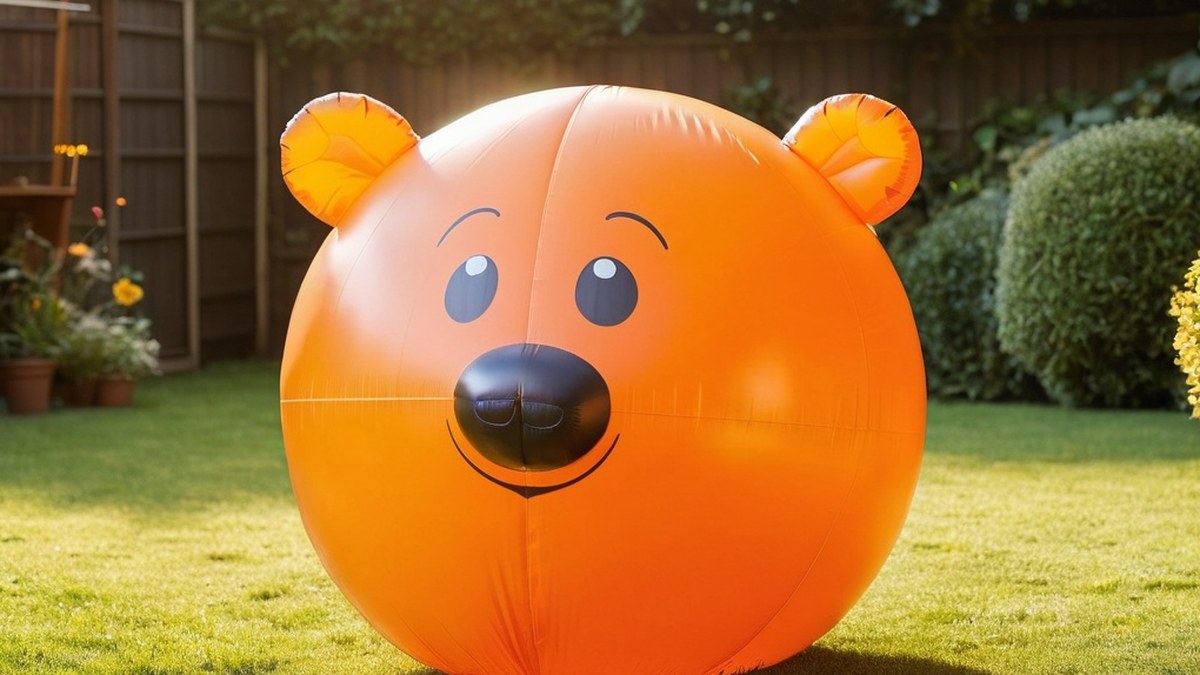
It had a face, which was the first strange thing about it. Two small horns, a pair of painted eyes, a snout — the Spacehopper was officially modelled on nothing in particular, a vaguely goat-like or ram-like creature rendered in bright orange vinyl, with two stubby plastic handles sticking out either side of its head like something you’d grip to steer an animal that had no steering mechanism whatsoever. You climbed on, gripped the horns, and bounced, and that was the entire design brief. There was nothing else it was trying to be.
The Spacehopper arrived in Britain in 1971, imported and licensed by the toy company Mettoy, having originated in Italy as the “Pon Pon” a few years earlier. Its arrival coincided neatly with the early 1970s fascination with the space race, and the name — chosen for marketing rather than any literal connection to spaceflight — stuck in a way that made the toy feel futuristic even though its mechanism was about as low-tech as a toy could be: an inflatable rubber ball, slightly pear-shaped, with handles moulded onto the front.
The Physics of Looking Ridiculous
Riding a Spacehopper correctly required you to sit directly on top of the bulb, grip the horns, and propel yourself forward by bouncing — a motion that used your entire body weight to compress the ball slightly on each landing, so that the rebound carried you forward a few inches at a time. Mastering it took longer than you’d expect for something this simple. Beginners bounced in place, or tipped sideways, or over-rotated and ended up facing the wrong way entirely, legs splayed, dignity in freefall along with the rest of them.
Children who had put in the hours could cover genuine distance — down a garden path, along a pavement, in races against siblings and friends that had no formal rules beyond “first one to the end wins” and no formal safety provisions beyond whatever grass or gravel happened to be underneath. Falling off was constant and largely consequence-free, cushioned by the fact that a Spacehopper accident generally involved toppling a foot or two sideways onto a lawn rather than anything more dramatic. The real risk, rarely discussed at the time, was the pavement version of the same fall.
There was a specific, universally recognised Spacehopper posture — knees slightly bent, torso upright, an expression of fierce concentration undercut entirely by the fact that you were bouncing around on an inflatable orange goat — and photographs of this exact posture exist in family albums across the country, usually a child in flared trousers or a knitted tank top, bouncing somewhere in a back garden in front of a washing line, utterly unselfconscious about how it looked.
A Toy That Doubled as Exercise Equipment
What the Spacehopper actually was, underneath the branding, was a piece of rudimentary exercise equipment decades before anyone marketed a “bouncing fitness ball” to adults in a gym. The repetitive bouncing motion built genuine leg strength and balance in a way few other playground toys did, and because it required active, sustained physical effort rather than passive play, parents tended to approve of it instinctively, even if nobody articulated the fitness angle at the time. It simply looked like healthy outdoor exertion, which it was, dressed up as a joke.
The toy also had a brief life as organised competitive sport. Spacehopper races were a staple of school sports days and children’s television segments through the 1970s, usually run in heats across a short straight course, with the inherent comedy of the format — adults and children alike bouncing in ungainly fashion toward a finish line — providing most of the entertainment value regardless of who actually won. The format required no equipment beyond the hoppers themselves and a flat stretch of tarmac or grass, which made it an easy inclusion for school events with minimal setup.
Deflation, Puncture, and the End of an Era
Every Spacehopper owner has the same memory of the toy’s eventual demise: a puncture, usually from a thorn, a sharp stone, or an overenthusiastic landing on gravel, followed by the slow, mournful hiss of a toy losing its structural integrity in real time. Patching an inflatable vinyl ball with the sort of puncture-repair kit designed for bicycle tyres was a common, only partially successful intervention. More often, a punctured Spacehopper was simply retired, deflated, and left in a shed, its face now slightly collapsed, looking less like a goat and more like a sad orange puddle.
The toy’s first wave of popularity faded through the early 1980s as newer toys captured children’s attention, but it never fully disappeared, helped along by a wave of 1990s and 2000s nostalgia marketing that repositioned the Spacehopper as a knowing retro novelty — sold in gift shops and novelty catalogues to adults who remembered the original, often bought as a joke present before ending up, more often than advertised, actually being ridden around a garden by the nostalgic adult who received it.
Why It Still Means Something
The Spacehopper’s enduring hold on British memory isn’t really about the toy’s design, which was simple to the point of crudeness. It’s about the specific, universal experience of being a small child in control of something faintly absurd, in a decade that hadn’t yet decided children’s toys needed batteries or screens to be interesting. An inflatable rubber animal with handles was, on its own, enough of a proposition to hold a child’s attention for an entire summer. It asked for nothing but your own effort and balance, gave you a faceful of orange vinyl and a slightly ridiculous silhouette in return, and somehow that was exactly enough.