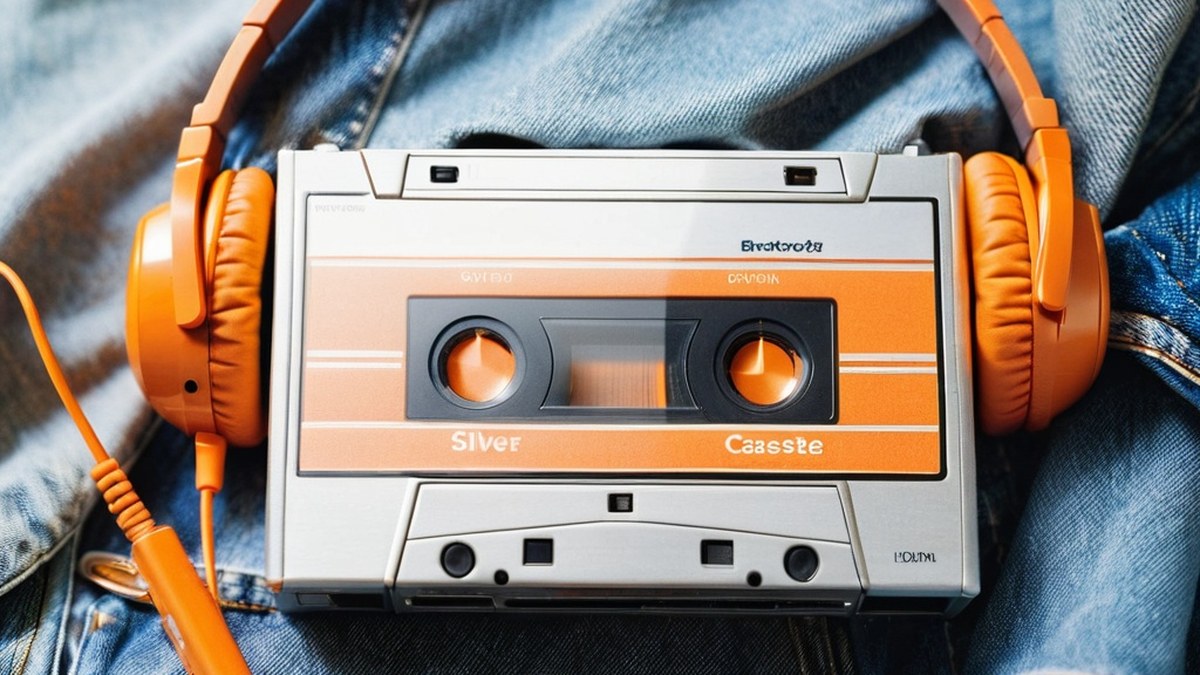
The Sony Walkman: The Device That Made Music Personal
Before earbuds and streaming, a small cassette player with foam headphones changed what music could mean — and who it could belong to.
There’s a photograph that circulates online occasionally, taken somewhere in a Western city in the early 1980s. A teenager is walking down a busy pavement, headphones on, eyes forward, entirely unreachable. The people around him are just people. He is somewhere else. The image is remarkable mostly because of what it wasn’t remarkable at the time — within a few years of the Walkman’s release, this was just what teenagers looked like.
That sense of private immersion, of being surrounded by the world while belonging entirely to your own soundtrack, didn’t come from a smartphone or an iPod. It came from a small Japanese cassette player that weighed 390 grams and changed the entire meaning of the word “personal” when applied to music.
How It Began
Sony’s co-founder Masaru Ibuka wanted to listen to opera on long flights. The story goes that he approached audio engineer Nobutoshi Kihara and asked if anything could be done — a portable cassette player, small enough to carry, light enough not to be absurd. Kihara adapted an existing Sony recording device, the TC-D5, stripping out its recording function to make space and reduce cost. The result was the TPS-L2, released in Japan in July 1979.
Sony’s internal research had predicted failure. The device had no recording capability, which the company believed was essential. Nobody would pay for a playback-only machine. When the idea was brought before a product committee, it was reportedly rejected outright. Ibuka and company chairman Akio Morita overruled the committee and pushed the TPS-L2 to market anyway.
The retail price in Japan was ¥33,000 — roughly equivalent to £110 or $150 in 1979 money. That was serious cash for a consumer electronics device. Sony set an initial production run of 30,000 units and hoped they’d sell out within a few months. They sold out in under two months. The Walkman had arrived.
The Object Itself
The original TPS-L2 came with two headphone jacks — Sony’s somewhat optimistic assumption being that people would want to share the experience. They were wrong about that. The Walkman turned out to be a profoundly solo device. Later models dropped the second jack.
The headphones that came with early Walkmans were foam-padded, featherweight, and about as technologically primitive as you could get while still technically being headphones. They rested on the ear rather than around it. They leaked sound constantly — anyone sitting near a Walkman user could hear a thin metallic version of whatever was playing, like music heard through a wall. But they weighed almost nothing, and that was what mattered.
The device itself had a belt clip built in. This was not a feature Sony offered as an afterthought — the belt clip was integral to the design philosophy. You wore the Walkman. It went on your body. You moved with it. Early advertising showed joggers and cyclists and commuters wearing the device clipped to waistbands and jacket pockets. This was radical. Music, previously, was something you sat still for.
The Culture That Built Around It
The Walkman hit the United States market in June 1980, retailing as the “Soundabout” — Sony’s American marketers weren’t sure the name “Walkman” would land, a concern that turned out to be wildly misguided. By 1981, it was the Walkman everywhere. The word entered the Oxford English Dictionary. Japan’s government briefly complained that the anglicised brand name was embarrassing for a Japanese company. Sony didn’t change it.
What the Walkman did, culturally, was give teenagers a private space inside public space. Before the Walkman, listening to music in public meant either carrying a boombox — a deliberately communal, social act — or waiting until you got home. The Walkman collapsed that waiting. Music became continuous, personal, and crucially, hidden. You could be on the bus to school, headphones on, inside something nobody around you could hear or judge.
The device also accelerated cassette culture enormously. If you were going to carry a personal player, you needed personal tapes — which meant making mixtapes, buying pre-recorded cassettes, building a small collection specifically calibrated to your moods and journeys. Cassette sales had been growing since the early 1970s, but Walkman ownership turned them into an identity statement. What you had on tape, and which tapes you carried in your bag on any given day, said something about who you were.
The Knockoffs and the Competition
Wherever Sony leads, the market follows. Within a year of the Walkman’s release, competitors were pouring out of factories across Japan, Hong Kong, and Taiwan. Aiwa, Sanyo, and Toshiba all launched their own portable players. The generic category name — borrowed from the Walkman brand — became “personal stereo,” a phrase that managed to be both clinical and rather glamorous.
The knockoffs ranged from near-perfect replicas to barely functional curiosities. British market stalls in the early 1980s sold unbranded personal stereos for under £10. They worked, mostly, for a while, and then the tape head would drift out of alignment and everything would sound slightly wrong, or the motor would start running slow and your favourite songs would gradually deepen in pitch like a singer losing energy.
Sony responded by innovating relentlessly. The Walkman range grew to include models with auto-reverse, Dolby B noise reduction, built-in FM radio, and eventually the solar-powered WM-F5. By the mid-1980s, the Walkman wasn’t just a product — it was a platform with dozens of models at different price points, each model number tracked obsessively by buyers who wanted the best one.
What It Meant
The standard story of the Walkman is that it was a precursor — to the Discman, to the iPod, to streaming. A milestone on the road to something else. That framing undersells it.
The Walkman was not a stepping stone. It was a genuine rupture in the relationship between people and music. For the entire prior history of recorded sound, music had been something that existed in a place — in a concert hall, in a living room, coming out of a radio or a record player fixed to one location. The Walkman made music placeless. It made it yours in a way it had never quite been before.
You didn’t go somewhere to hear music anymore. Music went where you went. It scored your commute and your walk home and your late-night study sessions. It became the connective tissue of your days. The particular feeling of finding a song that was exactly right for the particular weather and the particular mood of a Tuesday morning in November — that feeling, which millions of people have experienced with earbuds and streaming services — that started with a small Sony device and a pair of foam headphones, clipped to someone’s jeans, in 1979.