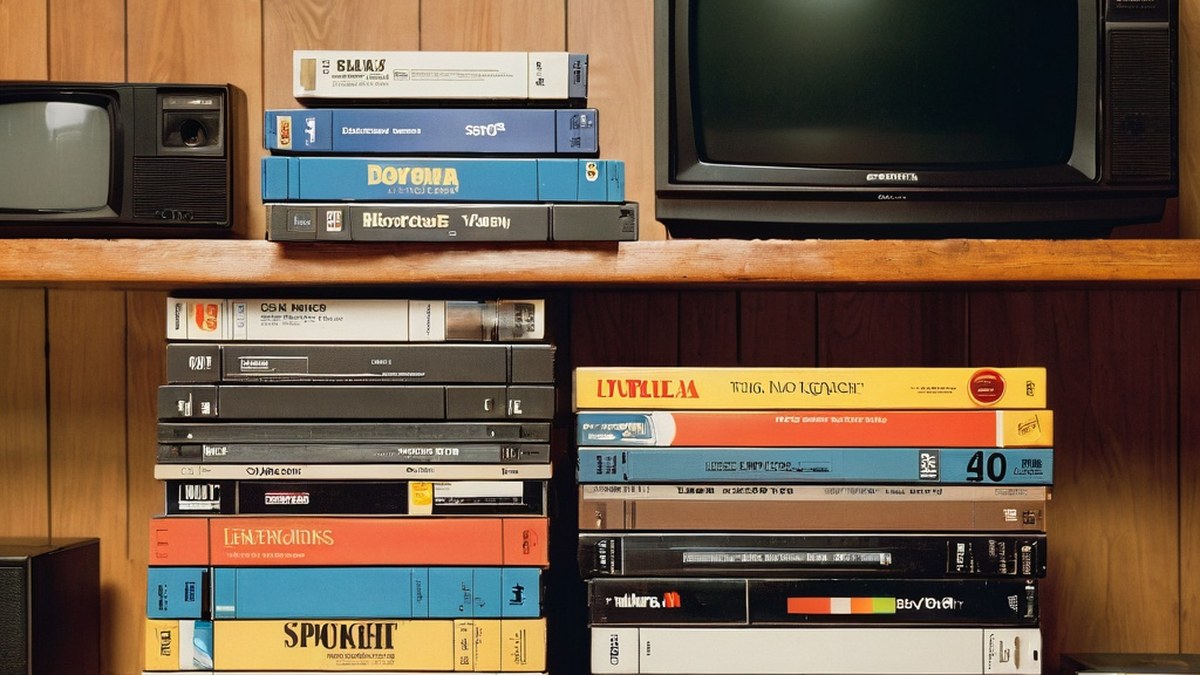
VHS Tapes: The Cassette That Ate Saturday Night
They were bulky, they degraded, they ate your favourite film if the mechanism was having a bad day. And yet the VHS tape was the foundation of home cinema for two decades.
Picture a Saturday afternoon in 1991. You’re in the living room, the carpet slightly worn in the spot in front of the television, and you’re sliding a black plastic brick into the slot on the front of a machine roughly the size of a briefcase. There’s a mechanical whirr, a soft thunk as the tape engages, and then — after a moment that always felt slightly longer than it needed to be — the screen flickers to life. That thunk. That specific, satisfying thunk of a VHS tape seating itself in the mechanism. It was the sound of the evening beginning.
The VHS cassette, at its core, was a fairly inelegant solution to a complicated problem. It housed about 246 metres of half-inch magnetic tape wound around two spools inside a hard plastic shell roughly 18.8 centimetres long by 10.2 centimetres wide by 2.5 centimetres deep. It weighed around 200 grams. It was not subtle. But for approximately twenty years, from the mid-1970s through to the mid-1990s, it was the way ordinary people watched films in their own homes.
The Tape Inside the Box
JVC introduced the VHS format in Japan in 1976, and it reached American and European consumers the following year. The name stood for Video Home System, which told you everything about the pitch: this was a technology for the home, for ordinary families, not professionals or enthusiasts. The early machines were expensive — a VCR cost somewhere between $1,000 and $1,300 in the late 1970s, which adjusted for inflation puts it well above $5,000 today — but prices fell steadily through the 1980s, and by the middle of that decade, the VCR had become a standard household fixture.
The tapes themselves had a peculiar taxonomy that most people understood intuitively without ever reading the manual. SP mode — Standard Play — gave you the best picture quality and fitted two hours of content onto a standard T-120 cassette. LP mode stretched that to four hours at a modest quality reduction. EP mode, also called SLP, gave you six hours by crawling the tape through at the slowest possible speed, producing an image that looked like it had been transmitted through fog. Serious home recorders used SP for things they cared about and EP for things they didn’t — recording overnight broadcasts, stacking up daytime TV — and most people had a drawer full of tapes labelled in handwriting that had grown increasingly illegible over the years.
The Library in the Cabinet
Something happened once VHS became affordable: people started building libraries. Not just renting tapes from the video shop but actually owning them, accumulating them, storing them in dedicated wooden cabinets with little plastic label holders on each slot. By the late 1980s, prerecorded VHS tapes had dropped in price from the absurd early retail figures — some titles had originally sold for $80 or more — to something closer to $20 for mainstream releases. Disney sold their animated features this way, releasing titles in carefully managed windows. The 1988 release of Cinderella for home purchase was a major event. Families bought it not just to have it but to have it, to own a piece of something.
The home-recorded library was a parallel institution. Blank T-120 tapes cost a few dollars each, and people filled them with everything. Films taped off the television, always slightly imperfect because someone had forgotten to remove the adverts or had talked over the opening credits. Television series recorded episode by episode across multiple tapes, the spines labelled in marker. Events — a royal wedding, a World Cup final, the space shuttle launch — saved for posterity on magnetic tape that would, over the following decade, quietly degrade.
The Timer Nobody Could Program
The VCR’s timer recording function was one of the great sources of domestic tension in the 1980s and 1990s. The concept was simple enough: you told the machine what channel to record, what time to start, what time to stop, and it would do the rest while you were out or asleep. The execution was something else entirely.
The interfaces varied by manufacturer but shared a common philosophy of extreme user hostility. On many machines, setting the timer involved navigating a series of menus using buttons whose labels had been worn off after a year of use, entering times in a format that was slightly but crucially different from any clock you had ever read, and confirming your settings through a sequence of button presses that had to be performed in the correct order or the machine would silently do nothing. The clock display — flashing 12:00 in the homes of millions of people who had simply given up — was only the most visible symptom of this problem.
Families developed workarounds. There was always one person in the household, usually whoever was youngest and most patient, designated as the timer programmer. Or people simply stayed home rather than risk missing something. Or they accepted that they would sometimes come home to find three hours of a completely different channel than intended, the wrong night’s programming, a silent tape.
Wear, Tracking, and the Tape That Ate Itself
Magnetic tape degrades. This is not a design flaw — it is a physical fact — but it was a fact that became personal when it was your copy of Raiders of the Lost Ark that started showing the symptoms. The image would develop horizontal bands of static. The colour would bleed at the edges of high-contrast objects. In advanced cases, the picture would roll, or break up entirely, or the tape would squeal as it ran through the mechanism.
The tracking adjustment dial on most VCRs was an attempt to compensate. By fine-tuning how the heads aligned with the tape, you could sometimes coax a cleaner image from a worn cassette. Experienced users developed a feel for it — a fraction of a turn clockwise, check the picture, a fraction back. The tape that had been rented too many times, played on too many machines with slightly different head alignments, had a particular texture of degradation: not a uniform fade but a kind of shimmering uncertainty, as if the image couldn’t quite commit to being there.
The most dramatic failure mode was the tape eating itself. The spools inside the cassette could catch, the tape would bunch up inside the machine, and you would open the VCR to find yards of brown magnetic tape accordioned against the mechanism in a way that felt like a small personal catastrophe. Some tapes could be rescued — carefully rewound by hand with a pencil inserted into one of the spools — but others were simply gone.
What the Stack of Tapes Actually Was
By the time DVD arrived in the late 1990s and started its rapid displacement of VHS, most households had accumulated a stack of tapes that was really a kind of accidental autobiography. The tapes a family owned told a story: what they’d valued enough to buy outright, what films they’d taped off television and thought worth keeping, which birthdays and Christmases had been significant enough to record. The label handwriting alone — different pens, different hands, dates ranging across a decade or more — was a document of time passing.
The transition away from VHS was unsentimental in practice but slightly melancholy in retrospect. People boxed up their collections or left them at charity shops, not thinking too hard about what was in them. The tapes themselves mostly went to landfill. The recordings of the television programmes nobody thought to digitise, the home movies on the unlabelled tapes at the back of the cabinet, the film someone had carefully taped off Channel 4 at midnight in 1987 — most of it is simply gone now.
The thunk of the tape seating itself in the mechanism was, without anyone fully realising it at the time, also the sound of something being saved. Even if only temporarily. Even if imperfectly. The VHS tape was a machine for holding onto things, and the tragedy is not that it failed at that job but that it succeeded well enough that people trusted it, for twenty years, to do it alone.